################################################################################
# Script Name: process.r
# Description: Analyse descriptive des mobilités résidentielles en finistère
#              entre 2020 et l'années de résidence prédédent. Données de l'INSEE.
#              Ce script est dédié à la cartograpie des indices calculés dans le
#              script `scripts/process.r`
# Author: Antoine Le Doeuff
################################################################################

library(readr)
library(sf)
library(dplyr)
library(Matrix)
library(ggplot2)
library(ggspatial)
library(ggnewscale)
library(patchwork)
library(ttt) # remotes::install_github("MiboraMinima/ttt")
library(mapsf)
library(ggtext)

# //////////////////////////////////////////////////////////////////////////////
# Constantes -------------------------------------------------------------------
# Où sont enregistré les données (vous, ce sera juste `data`)
DATA_DIR <- "02_flux/data"

# Où seront enregistrées vos cartes (vous, ce sera juste `figures`)
FIGURES_DIR <- "02_flux/figures"

# //////////////////////////////////////////////////////////////////////////////
# Chargement des données -------------------------------------------------------
# Le tableau des mobilités résidentielles filtées
dt_mobi_fin <- read_csv(glue::glue("{DATA_DIR}/res/mobi_res_29.csv"))

# Table des indices spatiaux
indices_spa <- read_sf(glue::glue("{DATA_DIR}/res/indices_spa_29.gpkg"))

# Communes du finistères
coms <- read_sf(glue::glue("{DATA_DIR}/src/com_finistere_bdtopov3_2026.gpkg"))

# Matrice des relations préférentielles
m_pref <- readRDS(glue::glue("{DATA_DIR}/res/rel_pref.rds"))

# //////////////////////////////////////////////////////////////////////////////
# Prétraitements ---------------------------------------------------------------
# Calcul des centroïdes (pour les cartes en cercles proportionnelles)
centroids <- st_centroid(indices_spa)

# //////////////////////////////////////////////////////////////////////////////
# Cartographie -----------------------------------------------------------------
# Themes .......................................................................
# Je crée un thème que j'appliquerai à toutes les cartes
sysfonts::font_add_google(name = "Roboto", family = "roboto")
theme_ggplot <-
  theme_minimal() +
  theme(
    legend.position = "bottom",
    # La font chargé dans `text` est automatiquement appliquée à tous les
    # autres texts de l'objet ggplot. Vous pouvez la changer manuellement
    # pour un paramètre en particulier si vous le shouaitez.
    text            = element_text(family = "roboto"),
    plot.title      = ggtext::element_markdown(size = 16, face = "bold"),
    plot.subtitle   = ggtext::element_markdown(size = 12, lineheight = 1.2),
    axis.title.x    = ggtext::element_markdown(size = 12),
    axis.title.y    = ggtext::element_markdown(size = 12),
    plot.caption    = ggtext::element_markdown(size = 8, lineheight = 1.5),
    legend.title    = ggtext::element_markdown(size = 8)
  )
# Theme pour patchwork
theme_patch <-
  theme(
    text          = element_text(family = "roboto"),
    plot.title    = element_text(face = "bold", size = 18),
    plot.subtitle = ggtext::element_markdown(size = 14, lineheight = 1.2),
    plot.caption  = ggtext::element_markdown(size = 11)
  )

# Plot departure, arrival, volumes .............................................
# On défini le nom complet de le la variable avec un named vector
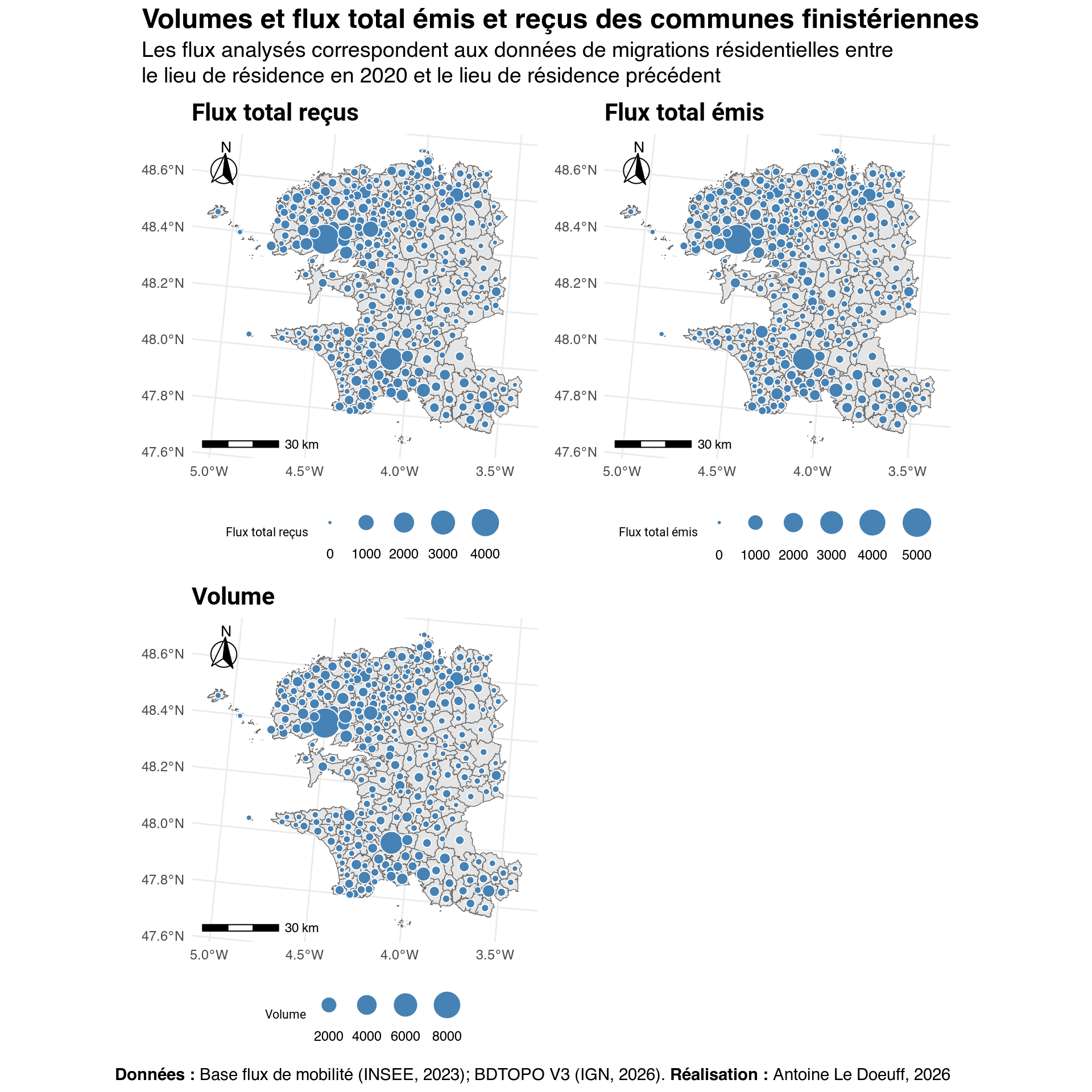
selected_vars <- c(
  "Flux total reçus" = "arrival",
  "Flux total émis"  = "departure",
  "Volume"           = "volumes"
)

# On définit une liste vide (réceptacle qui va recevoir les cartes)
maps <- list()

# On itère sur les noms
for (name in names(selected_vars)) {
  # On récupère le nom présent dans le tableau à partir du nom complet
  short_name <-  selected_vars[name]

  # Créée la carte
  m <- ggplot() +
    geom_sf(data = coms) +
    geom_sf(
      data = centroids,
      aes(size = .data[[short_name]]),
      pch = 21, fill = "steelblue", color = "white"
    ) +
    scale_size(
      name = name,
      range = c(1, 9),
      breaks = scales::pretty_breaks(n = 5)
    ) +
    ggtitle(name) +
    ggspatial::annotation_scale(
      location = "bl", height = unit(0.15, "cm")
    ) +
    ggspatial::annotation_north_arrow(
        location = "tl", which_north = "true",
        height = unit(1, "cm"), width = unit(1, "cm"),
        style = north_arrow_fancy_orienteering
    ) +
    guides(
      size = guide_legend(
        direction = "horizontal",
        nrow = 1,
        label.position = "bottom"
      )
    ) +
    theme_ggplot

  maps[[name]] <- m
}
# Je combine les graphs et je fais la mise en page de la carte finale
map_volumes_emis_recus <- patchwork::wrap_plots(maps, ncol = 2) +
  plot_annotation(
    title = "Volumes et flux total émis et reçus des communes finistériennes",
    subtitle = "Les flux analysés correspondent aux données de migrations résidentielles entre<br>le lieu de résidence en 2020 et le lieu de résidence précédent",
    caption = "**Données :** Base flux de mobilité (INSEE, 2023); BDTOPO V3 (IGN, 2026). BDTOPO V3 (IGN, 2026). **Réalisation :** Antoine Le Doeuff, 2026",
    theme = theme_patch
  )
# J'enregistre la carte
ggsave(
  glue::glue("{FIGURES_DIR}/map_volumes_emis_recus.png"),
  map_volumes_emis_recus,
  width = 21 - 1, # Largeur en cm (A4 moins 1 cm pour la marge)
  height = 27 - 1,
  units = "cm", dpi = 300
)
# J'enregistre la carte en .eps ou svg ou pdf (pour pouvoir la modifier avec
# logiciel de DAO a prosteriori)
ggsave(
  glue::glue("{FIGURES_DIR}/map_volumes_emis_recus.eps"),
  map_volumes_emis_recus,
  width = 21 - 1, # Largeur en cm (A4 moins 1 cm pour la marge)
  height = 27 - 1,
  units = "cm"
)

# Solde ........................................................................
# Création de la taille des cercles à la main
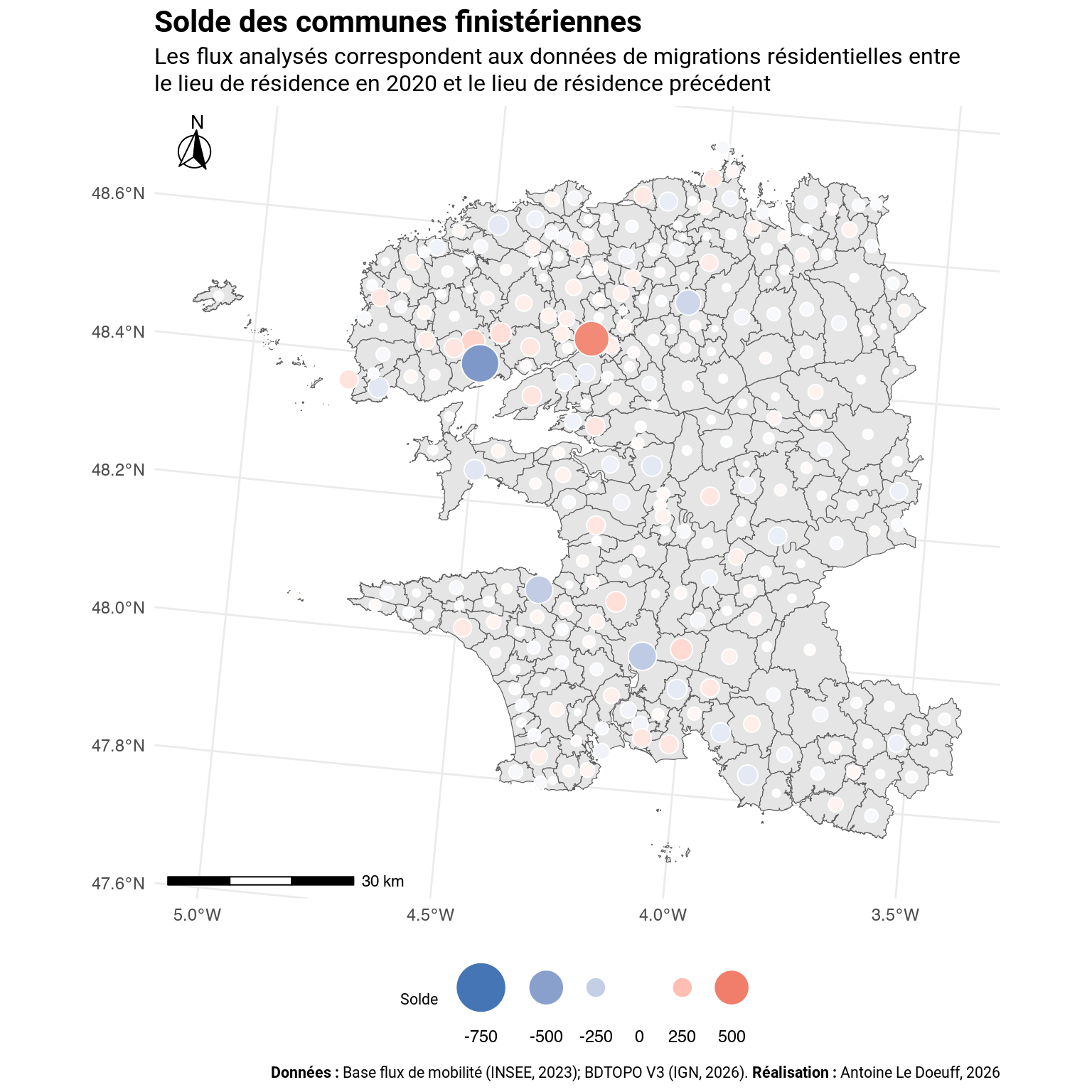
fill_breaks <- c(-750, -500, -250, 0, 250, 500)
max_val <- max(abs(centroids$soldes), na.rm = TRUE)
legend_sizes <- scales::rescale(abs(fill_breaks), to = c(1, 9), from = c(0, max_val))

map_solde <- ggplot() +
  geom_sf(data = coms) +
  geom_sf(
    data = centroids,
    aes(size = abs(soldes), fill = soldes),
    pch = 21, color = "white"
  ) +
  # Cacher la taille dans la légende
  scale_size(range = c(1, 9), guide = "none") +
  scale_fill_gradient2(
    name = "Solde",
    low = "#4575B4",
    mid = "white",
    high = "#D73027",
    midpoint = 0,
    space = "Lab",
    breaks = fill_breaks,
    limits = c(-750, 500),
    guide = "legend"
  ) +
  guides(
    fill = guide_legend(
      direction = "horizontal",
      nrow = 1,
      label.position = "bottom",
      # Mettre la taille directement ici
      override.aes = list(size = legend_sizes)
    )
  ) +
  labs(
    title = "Solde des communes finistériennes",
    subtitle = "Les flux analysés correspondent aux données de migrations résidentielles entre<br>le lieu de résidence en 2020 et le lieu de résidence précédent",
    caption = "**Données :** Base flux de mobilité (INSEE, 2023); BDTOPO V3 (IGN, 2026). BDTOPO V3 (IGN, 2026). **Réalisation :** Antoine Le Doeuff, 2026"
  ) +
  ggspatial::annotation_scale(
    location = "bl", height = unit(0.15, "cm")
  ) +
  ggspatial::annotation_north_arrow(
      location = "tl", which_north = "true",
      height = unit(1, "cm"), width = unit(1, "cm"),
      style = north_arrow_fancy_orienteering
  ) +
  theme_ggplot
ggsave(
  glue::glue("{FIGURES_DIR}/map_solde.png"),
  map_solde,
  width = 20 - 1,
  height = 20 - 1,
  units = "cm", dpi = 300
)
ggsave(
  glue::glue("{FIGURES_DIR}/map_solde.pdf"),
  map_solde,
  width = 20 - 1,
  height = 20 - 1,
  units = "cm"
)

# Attractivity .................................................................
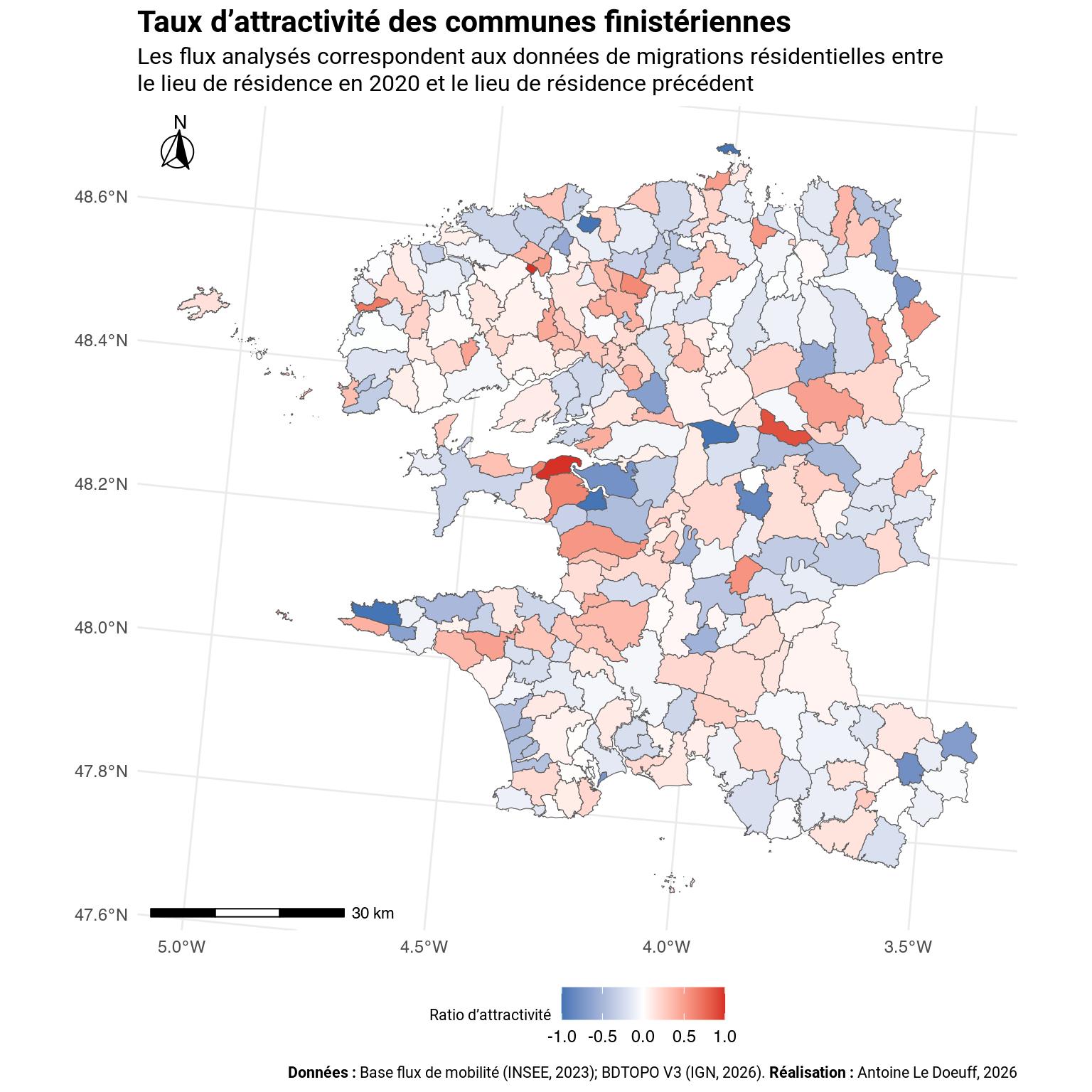
map_attrac_ratio <- ggplot() +
  geom_sf(
    data = indices_spa,
    aes(fill = attrac_ratio),  # use transformed color
    pch = 21
  ) +
  scale_fill_gradient2(
    name = "Ratio d'attractivité",
    low = "#4575B4",   # blue for negatives
    mid = "white",
    high = "#D73027",  # red for positives
    midpoint = 0,      # ensures 0 stays white
    space = "Lab"
  ) +
  labs(
    title = "Taux d'attractivité des communes finistériennes",
    subtitle = "Les flux analysés correspondent aux données de migrations résidentielles entre<br>le lieu de résidence en 2020 et le lieu de résidence précédent",
    caption = "**Données :** Base flux de mobilité (INSEE, 2023); BDTOPO V3 (IGN, 2026). BDTOPO V3 (IGN, 2026). **Réalisation :** Antoine Le Doeuff, 2026"
  ) +
  ggspatial::annotation_scale(
    location = "bl", height = unit(0.15, "cm")
  ) +
  ggspatial::annotation_north_arrow(
      location = "tl", which_north = "true",
      height = unit(1, "cm"), width = unit(1, "cm"),
      style = north_arrow_fancy_orienteering
  ) +
  theme_ggplot
ggsave(
  glue::glue("{FIGURES_DIR}/map_attrac_ratio.png"),
  map_attrac_ratio,
  width = 20 - 1,
  height = 20 - 1,
  units = "cm", dpi = 300
)
ggsave(
  glue::glue("{FIGURES_DIR}/map_attrac_ratio.eps"),
  map_attrac_ratio,
  width = 20 - 1,
  height = 20 - 1,
  units = "cm"
)

# Indices d'emmissivité et d'attractivité ......................................
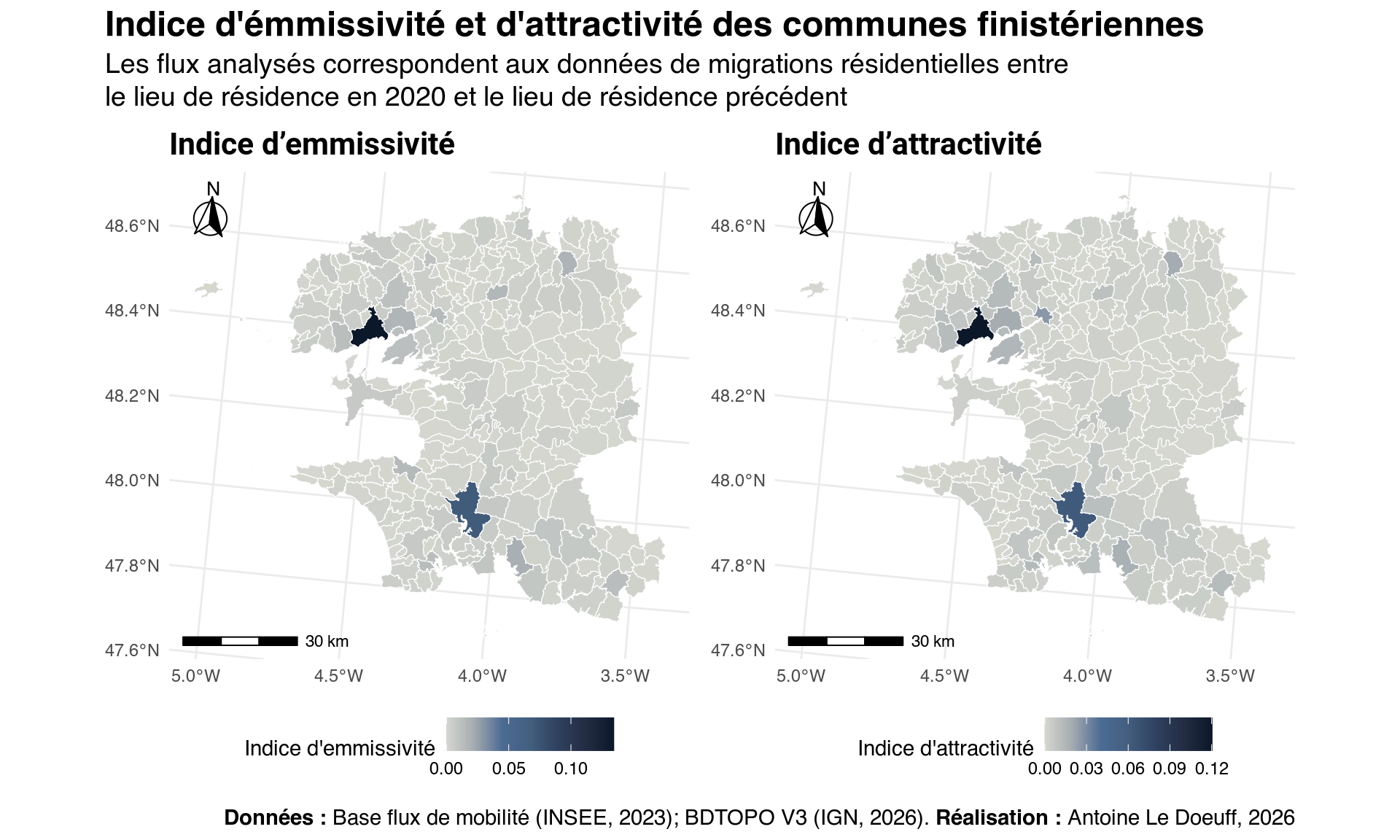
to_plot_vars <- c("Indice d'emmissivité" = "ie", "Indice d'attractivité" = "ia")
maps <- list()
for (name in names(to_plot_vars)) {
  short_name <- to_plot_vars[name]
  m <- ggplot() +
    geom_sf(
      data = indices_spa,
      aes(fill = .data[[short_name]]),
      color = "white",
      pch = 21
    ) +
    scale_fill_gradientn(
      name = name,
      colors = MexBrewer::mex.brewer("Frida"),
    ) +
    labs(title = name) +
    ggspatial::annotation_scale(
      location = "bl", height = unit(0.15, "cm")
    ) +
    ggspatial::annotation_north_arrow(
        location = "tl", which_north = "true",
        height = unit(1, "cm"), width = unit(1, "cm"),
        style = north_arrow_fancy_orienteering
    ) +
    theme_minimal() +
    theme(
      legend.position = "bottom",
      plot.title   = ggtext::element_markdown(family = "roboto", size = 16, face = "bold"),
      plot.subtitle = ggtext::element_markdown(family = "roboto", size = 12, lineheight = 1.2),
      axis.title.x = ggtext::element_markdown(family = "roboto", size = 12),
      axis.title.y = ggtext::element_markdown(family = "roboto", size = 12),
      plot.caption = ggtext::element_markdown(family = "roboto", size = 8, lineheight = 1.5)
    )
  maps[[short_name]] <- m
}
map_ia_ie <- patchwork::wrap_plots(maps) +
  plot_annotation(
    title = "Indice d'émmissivité et d'attractivité des communes finistériennes",
    subtitle = "Les flux analysés correspondent aux données de migrations résidentielles entre<br>le lieu de résidence en 2020 et le lieu de résidence précédent",
    caption = "**Données :** Base flux de mobilité (INSEE, 2023); BDTOPO V3 (IGN, 2026). BDTOPO V3 (IGN, 2026). **Réalisation :** Antoine Le Doeuff, 2026",
    theme = theme_patch
  )
ggsave(
  glue::glue("{FIGURES_DIR}/map_ia_ie.png"),
  map_ia_ie,
  width = 21 - 1, # Largeur en cm (A4 moins 1 cm pour la marge)
  height = 27 - 1,
  units = "cm", dpi = 300
)
ggsave(
  glue::glue("{FIGURES_DIR}/map_ia_ie.eps"),
  map_ia_ie,
  width = 21 - 1, # Largeur en cm (A4 moins 1 cm pour la marge)
  height = 27 - 1,
  units = "cm"
)

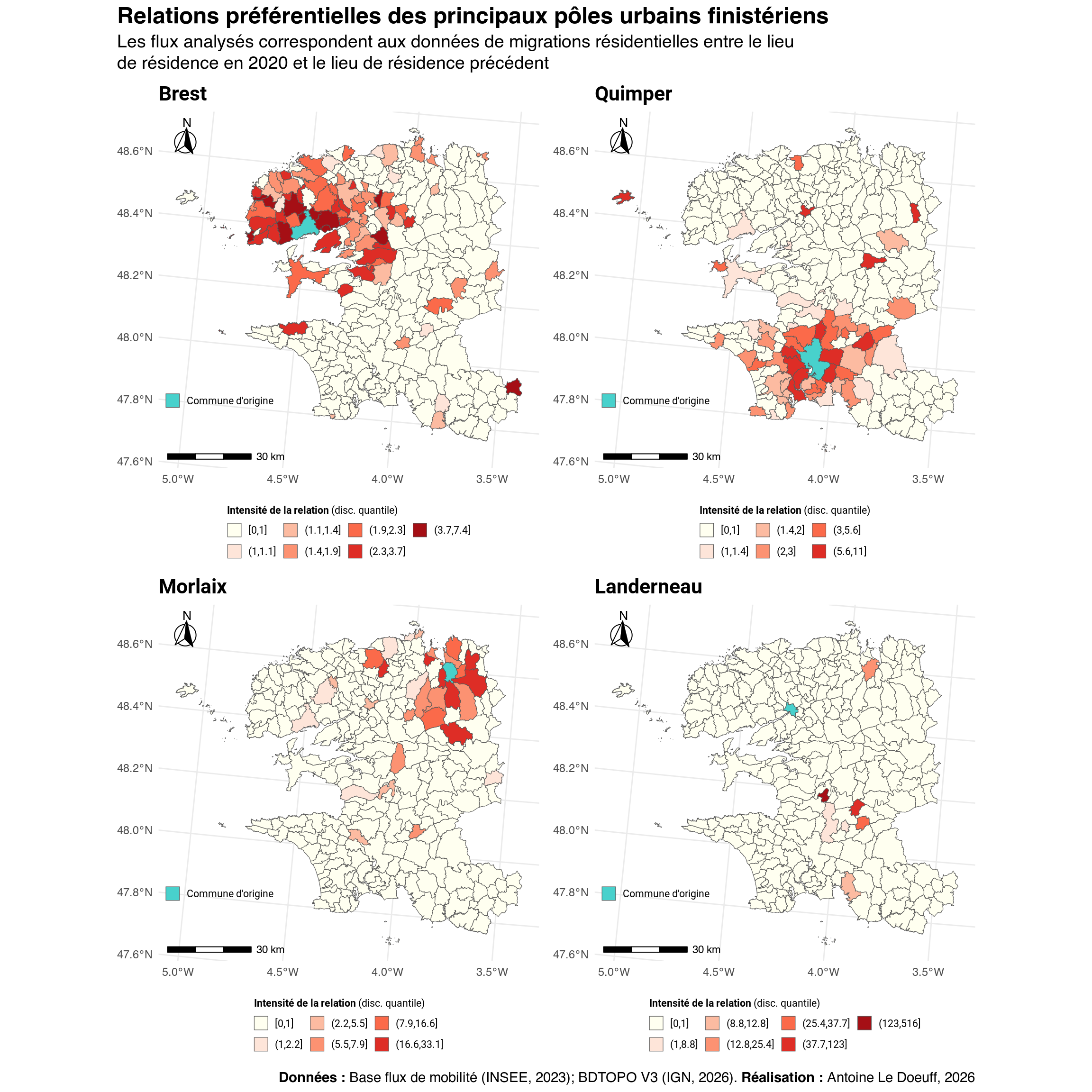
# Relations préférentielles ....................................................
# Conversion de la matrice des relations préférentielles en data.frame
od_tidy <- as.data.frame(as.matrix(m_pref)) |>
  tibble::rownames_to_column("origin") |>
  tidyr::pivot_longer(
    cols = -origin,
    names_to = "destination",
    values_to = "rel_pref"
  )

# Les communes que je souhaites cartographier
coms_to_plot <- c(
  "Brest"      = "29019",
  "Quimper"    = "29232",
  "Morlaix"    = "29151",
  "Landerneau" = "29041"
)
# Seuil de définition d'un relation préférentielle. Les relations inférieure à
# ce seuil ne seront pas cartographiées.
th <- 1

# Filtre du df des rel. pref. pour ne garder que les communes sélectionnées
# Ne garder que les communes sélectionnées
to_plot <- filter(od_tidy, origin %in% coms_to_plot)
# On récupère les géométries
to_plot <- left_join(indices_spa, to_plot, by = c("code_insee" = "destination"))

maps <- list()
for (com_name in names(coms_to_plot)) {
  ci <- coms_to_plot[com_name]
  data_current_com <-
    filter(to_plot, origin == ci) |>
    select(origin, rel_pref)

  # discrétisation quantile
  breaks <- quantile(
    pull(filter(data_current_com, rel_pref > th), rel_pref),
    probs = seq(0, 1, by = 0.2),
    na.rm = TRUE
  )
  # Ajouter la légende pour les valeurs < th (on round pour la légende)
  breaks <- round(c(0, 1, breaks), 1)
  # Créer une variable avec le seuil des quantiles
  data_current_com <- data_current_com |>
    mutate(
      rel_pref_q = cut(
        round(rel_pref, 1), # Il faut round ici aussi
        breaks = unique(breaks),
        include.lowest = TRUE,
        dig.lab = 3
      )
    )

  m <- ggplot() +
    geom_sf(data = data_current_com, aes(fill = rel_pref_q)) +
    scale_fill_manual(
      name     = "**Intensité de la relation** (disc. quantile)",
      # Mettre une couleur partiuclière pour les valeurs < 1 (th)
      values   = c("ivory", RColorBrewer::brewer.pal(6, "Reds")),
      na.value = "grey90",
      guide = guide_legend(
        position       = "bottom",
        direction      = "horizontal",
        title.position = "top",
        nrow           = 2
      )
    ) +
    new_scale_fill() +
    geom_sf(
      data = filter(coms, nom_officiel == com_name),
      aes(fill = "Commune d'origine")
    ) +
    scale_fill_manual(
      name   = NULL,
      values = c("Commune d'origine" = "mediumturquoise"),
      guide  = guide_legend(position = "inside")
    ) +
    labs(title = com_name) +
    ggspatial::annotation_scale(location = "bl", height = unit(0.15, "cm")) +
    ggspatial::annotation_north_arrow(
      location = "tl", which_north = "true",
      height = unit(1, "cm"), width = unit(1, "cm"),
      style = north_arrow_fancy_orienteering
    ) +
    theme_ggplot +
    theme(
      legend.position.inside      = c(0, 0.15),
      legend.justification.inside = c(0, 0),
      legend.key.size             = unit(0.4, "cm"),
      legend.text                 = element_text(family = "roboto", size = 8),
      legend.background           = element_rect(fill = NA, color = NA)
    )

  maps[[com_name]] <- m
}
map_rel_pref <- patchwork::wrap_plots(maps, ncol = 2) +
  plot_annotation(
    title = "Relations préférentielles des principaux pôles urbains finistériens",
    subtitle = "Les flux analysés correspondent aux données de migrations résidentielles entre le lieu<br>de résidence en 2020 et le lieu de résidence précédent",
    caption = "**Données :** Base flux de mobilité (INSEE, 2023); BDTOPO V3 (IGN, 2026). BDTOPO V3 (IGN, 2026). **Réalisation :** Antoine Le Doeuff, 2026",
    theme = theme_patch
  )
ggsave(
  glue::glue("{FIGURES_DIR}/map_rel_pref.png"),
  map_rel_pref,
  width = 21 - 1,
  height = 27 - 1,
  units = "cm", dpi = 300
)
ggsave(
  glue::glue("{FIGURES_DIR}/map_rel_pref.eps"),
  map_rel_pref,
  width = 21 - 1,
  height = 27 - 1,
  units = "cm"
)

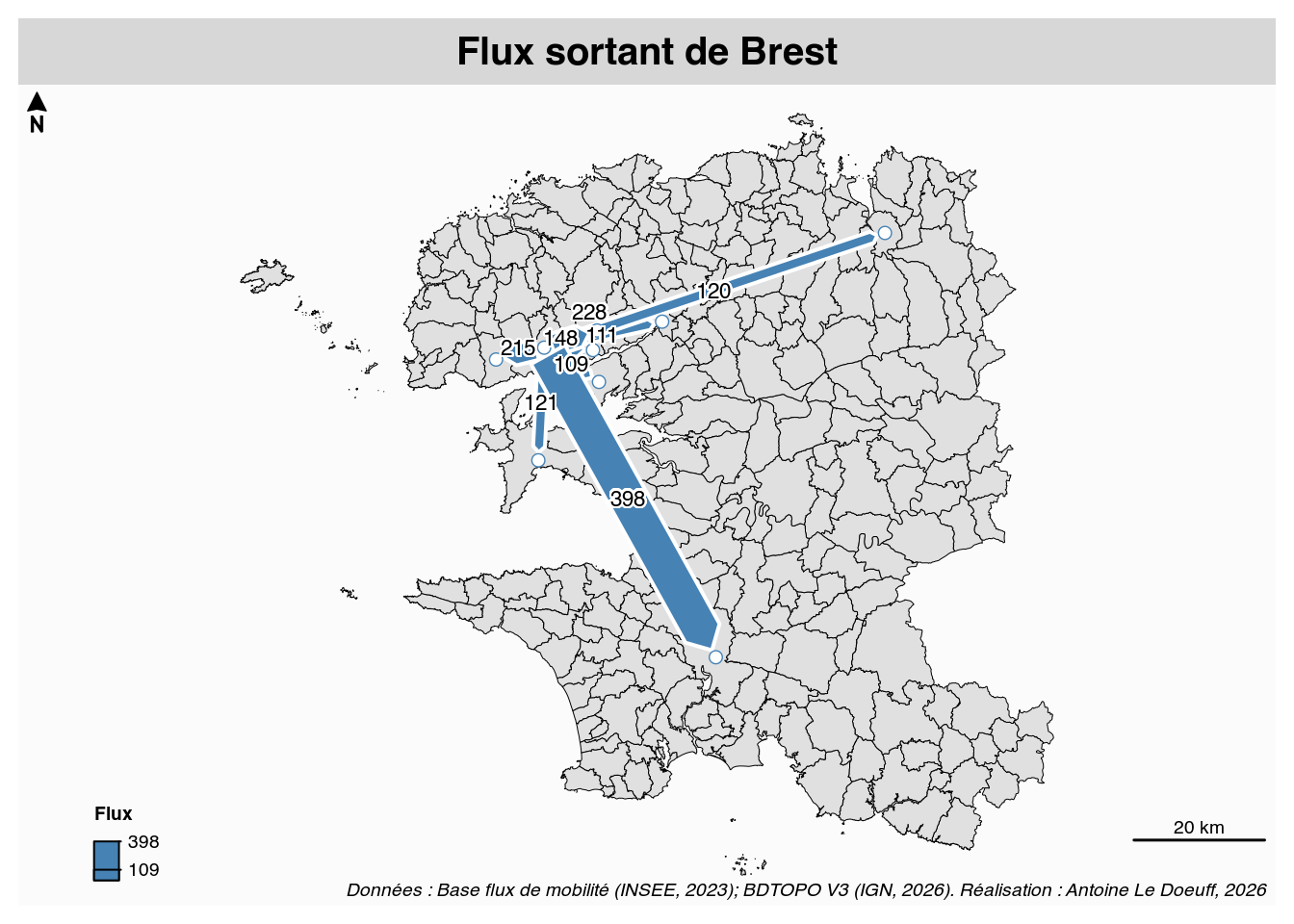
# Flux map .....................................................................
# [Prétraitements]
indices_spa$code_insee <- as.numeric(indices_spa$code_insee)
indices_spa$id <- indices_spa$code_insee
dtp <-
  select(dt_mobi_fin, -i, -j) |>
  mutate(i = as.numeric(codgeo), j = as.numeric(dcran), fij = nbflux_c20_pop01p) |>
  select(i, j, fij)

# [Paramètres]
# Les flux associées à la commune
com_name <- "Brest"
# Le type de flux que l'on souhaite cartographier
type <- "sortant" # "entrant"
# Récupération du code INSEE associé à la commune
ci <- unique(pull(filter(coms, nom_officiel == com_name), code_insee))
# Seuil pour cartographier les flux
th <- 100
# Couleur des lignes
col <- "steelblue"
# Couleur du fond de carte
col_back <- "#E0E0E0"

# [Carto]
# Récupérer tous les flux entrants ou sortants associés à la commune
# et filrer les flux < au seuil.
if (type == "entrant") {
  dt_plot <- filter(dtp, j == as.numeric(ci), fij > th)
} else {
  dt_plot <- filter(dtp, i == as.numeric(ci), fij > th)
}

# Créer un df avec les communes qui échange des flux
indices_spa_f <-
  filter(indices_spa, id %in% unique(c(dt_plot$i, dt_plot$j))) |>
  select(id)

# On enregistre ici l'endroit où va être sauvegardé la carte
mf_png(
  x = coms,
  filename = glue::glue("{FIGURES_DIR}/map_oursin_{type}_{com_name}.png"),
  width = 20 - 1, height = 20 - 1, unit="cm"
)
mf_map(
  coms,
  col = col_back,
  border = "black",
  lwd = 0.5
)
flows <- ttt_flowmapper(
  x = indices_spa_f,
  df = dt_plot,
  dfid = c("i", "j"),
  dfvar = "fij",
  xid = "id",
  size = "thickness",
  type = "arrows",
  decreasing = FALSE,
  # Configuration des lignes
  col = col,        # couleur des arcs
  border = "white", # couleur du contour
  lwd = 2,          # épaisseur du contour
  k = 15,           # augmenter ou diminuer l'épaisseur des arcs
  # Configuration des cercles
  col2 = "white", # couleur du cercle
  border2 = col,  # couleur du contour
  lwd2 = 0.7,     # épaisseur du contour
  k2 = 1e3L,      # augmenter ou diminuer la taille des cercles
  add = TRUE
)
# Ajouter la valeur du flux sur les arcs
# Si vous voulez les enlevez, commentez le code.
flows_txt <- mutate(flows$flows, fij = round(fij, 0)) |> distinct()
mf_label(
  flows_txt,
  var = "fij",
  halo = TRUE,
  cex = 0.7,
  col = "black",
  bg = "white",
  r = 0.1,
  overlap = FALSE,
  lines = FALSE
)
# La légende
ttt_flowmapperlegend(
  x = flows,
  title = "Flux",
  col = col,
  txtcol = 'black',
  title.cex = 0.6, # Taille du titre de la légende
  hshift = 3e3     # Espace entre le titre et légende
)
mf_title(
  txt = glue::glue("Flux {type} de {com_name}"),
  bg = "#d7d7d7", fg = "black", pos = "center"
)
mf_credits(
  txt = "Données : Base flux de mobilité (INSEE, 2023); BDTOPO V3 (IGN, 2026). BDTOPO V3 (IGN, 2026). Réalisation : Antoine Le Doeuff, 2026",
  col = "black", pos = "bottomright"
)
mf_arrow(col="black")
mf_scale(col="black", pos="bottomright", adj = c(0, 10))
dev.off() # Indique l'enregistrement de la carte avec les paramètres indiqués dans mf_png()